The Ultimate U.S. Diabetes Market Overview explores the current state of the U.S. diabetes market in the year 2025, breaking down key industry trends, major players, and technological innovations that are driving growth.
With rising diabetes prevalence and the need for more effective treatment options, the U.S. diabetes market is expanding rapidly, driven by technological innovations, new drug therapies, and an increasing focus on personalized diabetes management.
The Ultimate U.S. Diabetes Market Overview will help you discover high-quality data on the U.S. diabetes market, from glucose monitoring advancements to insulin delivery trends.
Stay ahead with insights on market drivers, competitors, and innovations shaping the future of diabetes care.
Table of Contents
➜ Diabetes in the U.S.: Prevalence and Market Impact
➜ Diabetes Care Devices Market Overview
➜ Market Drivers & Limiters
➜ Insulin Market Trends: GLP-1 Agonists and Next-Gen Insulin Devices
➜ Growth of Continuous and Flash Glucose Monitoring
➜ Leading Competitors in the Diabetes Market
➜ Future Outlook for the U.S. Diabetes Market
Key Takeaways
- The U.S. diabetes market is expected to surpass $75 billion by 2031, fueled by the increasing adoption of advanced monitoring and treatment devices.
- CGM and FGM technologies are rapidly replacing traditional blood glucose meters, offering real-time glucose monitoring with better accuracy.
- GLP-1 receptor agonists, such as Ozempic®, are revolutionizing diabetes treatment, reducing reliance on insulin while improving patient outcomes.
- Rising healthcare costs, regulatory hurdles, and pricing pressures are shaping the competitive landscape for diabetes monitoring and drug delivery solutions.
- AI-powered diabetes management tools and personalized digital health platforms are emerging as innovators in diabetes care.
Diabetes in the U.S.: Prevalence and Market Impact
What is the Diabetes Rate in the United States?
Diabetes remains one of the most significant public health concerns in the United States, with over 37 million Americans diagnosed as of 2024.
Type 2 diabetes remains the dominant form of the disease, accounting for over 90% of diagnosed cases. The total U.S. diabetes population is steadily increasing, driven by rising obesity rates, aging populations, and sedentary lifestyles.
By 2031, the number of diagnosed cases is expected to surpass current estimates at a CAGR of about 3%, placing a growing burden on healthcare systems.
How Big is the Diabetes Market in the U.S.?
The U.S. diabetes market was valued at nearly $49 billion in 2024 and is expected to grow almost double in size.
The total U.S. diabetes market, including monitoring, treatment, and drug delivery, is projected to grow at a CAGR of 7% through 2031, creating significant opportunities for healthcare providers, pharmaceutical companies, and medical device manufacturers.
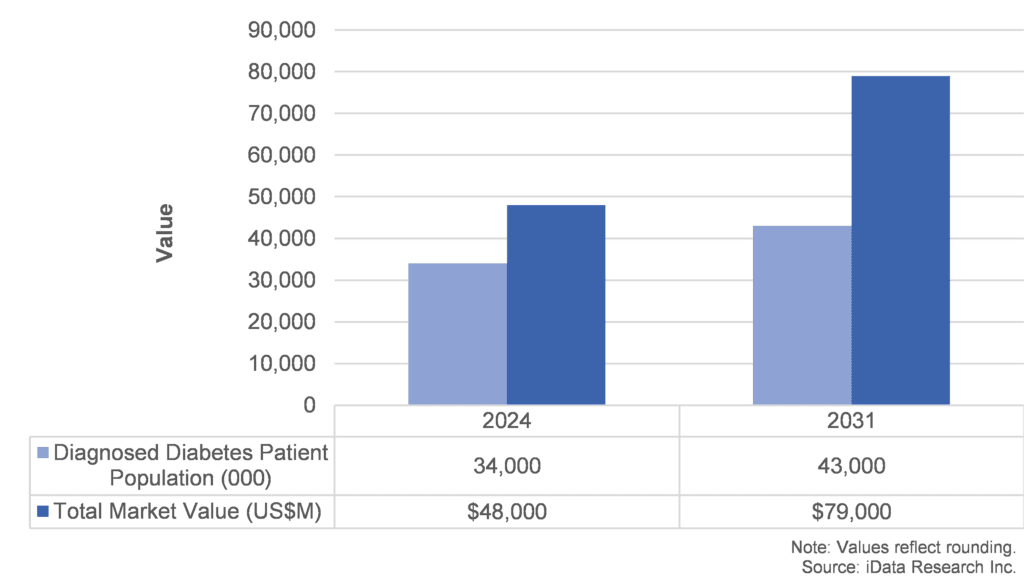
Market growth is being driven by technological advancements, increased adoption of wearable health devices, and demand for more personalized diabetes management solutions.
Some of the factors include:
- Expanding Patient Population: The number of diagnosed diabetes cases is significantly increasing, driving demand for monitoring, treatment, and drug delivery solutions.
- Technology-Driven Growth: Continuous glucose monitoring (CGM), flash glucose monitoring (FGM), and AI-powered insulin delivery systems are transforming diabetes management, leading to higher adoption rates.
- Rising Market Value: The total diabetes market is projected to grow substantially, with investments in GLP-1 receptor agonists, smart insulin pens, and digital health platforms shaping the future.
- Shifts in Treatment Preferences: Patients and healthcare providers are moving away from traditional insulin therapy in favor of GLP-1 receptor agonists and combination therapies, which offer greater efficacy and convenience.
Diabetes Care Devices Market Overview
The diabetes care devices market encompasses a wide range of technologies designed to help patients monitor and manage their blood sugar levels effectively.
Key Trends Shaping the U.S. Diabetes Care Devices Market:
- Declining demand for blood glucose meters and test strips as CGM and FGM technologies replace traditional fingerstick testing.
- Rapid growth in CGM adoption, with Dexcom, Abbott, and Medtronic leading the market.
- Advancements in smart insulin delivery systems, including automated insulin dosing algorithms and AI-powered insulin pens.
- Greater integration with telehealth and digital health platforms, enabling remote patient monitoring and real-time data sharing with healthcare providers.
Key Market Segments
Blood Glucose Meters & Test Strips
- Market growth is slowing with a CAGR of almost 1% due to the rise of CGM and FGM systems.
- Test strip demand is declining at a negative CAGR of around 4%, as more patients switch to sensor-based glucose monitoring.
Continuous Glucose Monitoring (CGM) & Flash Glucose Monitoring (FGM)
- Experiencing double-digit growth, expected to overtake traditional glucose testing by 2030.
- Leading CGM companies include Dexcom, Abbott, and Medtronic, all investing heavily in AI-driven glucose monitoring solutions.
Insulin Pumps & Smart Pens
- Increasing adoption due to improved accuracy and integration with digital health platforms.
- Once-weekly insulin delivery solutions are in development, expected to reshape patient adherence rates.
Market Drivers & Limiters
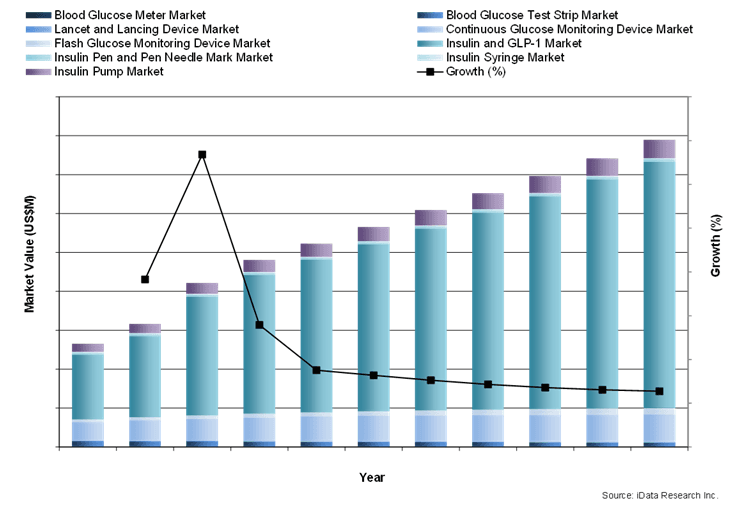
(Note: to see the full graph, download our U.S. Diabetes Market Report)
Key Growth Drivers
Challenges & Market Limiters
- Regulatory hurdles affecting pricing & reimbursement policies
- High costs associated with new diabetes technologies
- Competitive pricing pressures from emerging players
Insulin Market Trends: GLP-1 Agonists and Next-Gen Insulin Devices

How Big Is the U.S. Insulin Market?
(Insulin and GLP-1 Market by Segment, U.S., 2021 – 2031).
The U.S. insulin market was valued at $5 billion in 2024 and is projected to grow at a CAGR of 8% through 2031 as new treatment options gain traction
The shift towards non-insulin therapies, advanced insulin delivery systems, and GLP-1 receptor agonists is fundamentally reshaping diabetes treatment strategies.
The Rise of GLP-1 Receptor Agonists
The diabetes treatment landscape is rapidly evolving, with patients and healthcare providers embracing new, more effective treatment options.
- GLP-1 receptor agonists (e.g., Ozempic®, Mounjaro™) are reshaping the market, offering better blood sugar control, weight management benefits, and lower risk of hypoglycemia.
- Next-generation insulin delivery devices, including smart insulin pens, automated insulin pumps, and AI-powered dosing systems, are improving adherence and precision.
- Once-weekly insulin formulations, such as insulin icodec, are gaining attention as more convenient alternatives to daily injections.
Recent US Diabetes Market Trends:
- In 2024, GLP-1 agonists represented more than 60% of the total diabetes drug market, with continued dominance expected through 2031.
Mounjaro™ has outperformed Ozempic® in clinical trials, leading to increased market share for Eli Lilly over Novo Nordisk.
U.S. Insulin Delivery Market: Innovations in Pumps, Smart Pens, and Weekly Injections
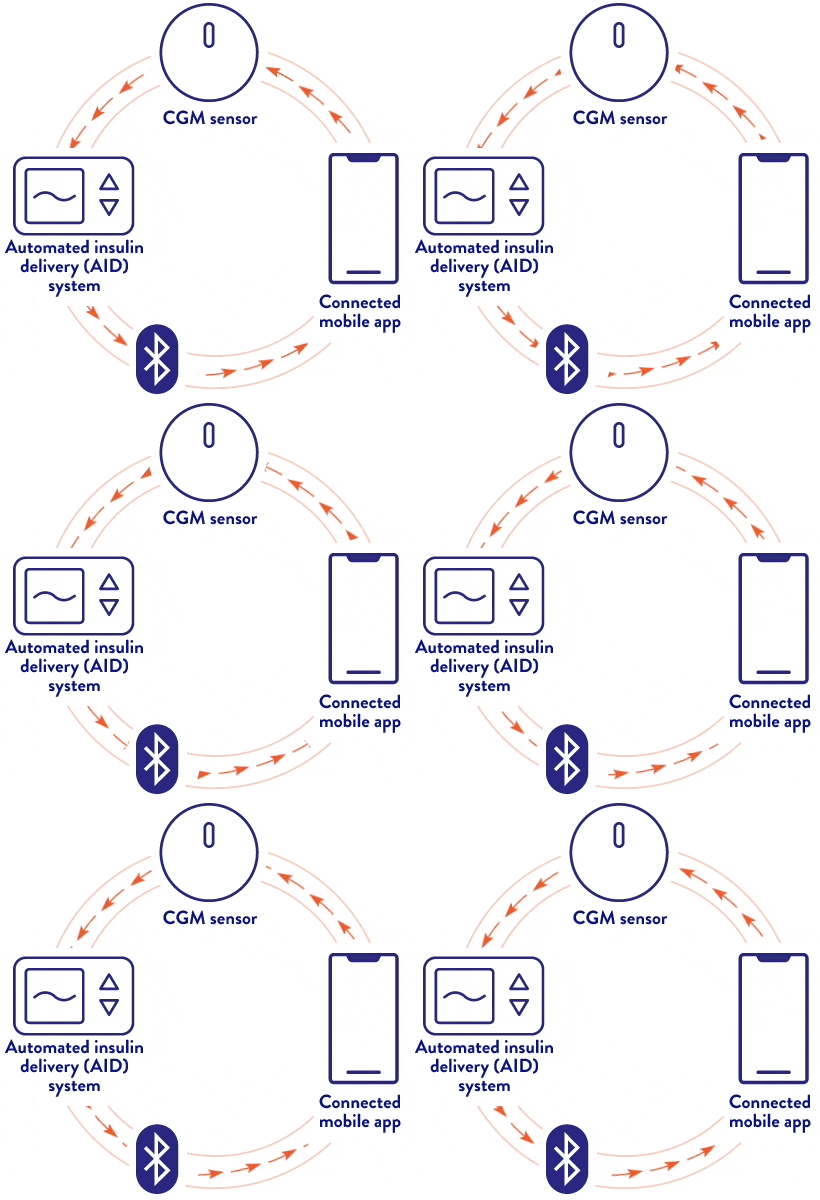
GIF source
While insulin remains a cornerstone of diabetes management, advancements in delivery methods are reshaping treatment approaches and improving patient adherence.
Traditionally, insulin therapy required daily injections or multiple doses per day, which many patients found difficult to manage. However, the emergence of next-generation insulin delivery systems is making diabetes care more precise, efficient, and user-friendly.
Here are some next-generation insulin delivery methods that are emerging:
Insulin Pumps & Automated Delivery Systems
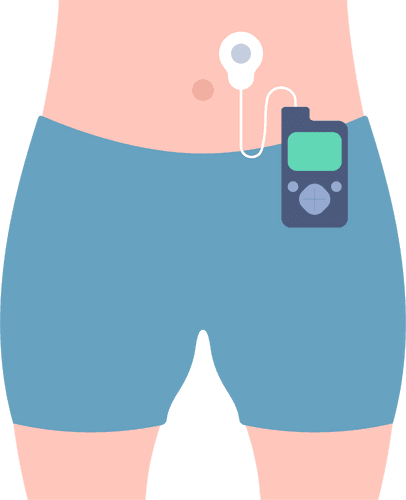
Insulin pump adoption is growing due to improved connectivity with CGM systems.
These insulin pumps now integrate with continuous glucose monitoring (CGM) systems, allowing automated insulin adjustments based on real-time glucose levels.
Hybrid closed-loop systems, or artificial pancreas technology, are evolving to automate insulin delivery, reducing the risk of hypo- and hyperglycemia.
Leading insulin pump manufacturers include:
- Tandem Diabetes Care
- Insulet (Omnipod)
- Medtronic
All investing in AI-powered dosing algorithms.
Smart Insulin Pens & Connected Devices
Smart pens track injection timing, dosage, and insulin usage, providing real-time data via mobile apps.
Some models integrate AI-driven dose recommendations, helping patients fine-tune insulin administration.
Leading smart insulin pen manufacturers include:
Both companies are making it more accessible and widely adopted.
Once-Weekly Insulin Therapy
Once-weekly insulin therapy is being developed to reduce the burden of daily injections, improving adherence.
Insulin icodec (Novo Nordisk) and basal insulin Fc (Eli Lilly) are among the most promising once-weekly insulin formulations currently in clinical trials.
These treatments could significantly simplify diabetes management for millions of patients by providing steady, long-acting insulin coverage.
Growth of Continuous and Flash Glucose Monitoring

GIF Source
Why Is CGM Replacing Traditional Blood Glucose Meters?
Continuous glucose monitoring (CGM) and flash glucose monitoring (FGM) have become the gold standard for glucose tracking, significantly reducing reliance on traditional fingerstick blood glucose meters.
CGM technology offers:
- Real-time glucose monitoring with alerts for hypo/hyperglycemia
- Seamless integration with insulin pumps & smart devices
- Fewer painful fingersticks, improving patient compliance
FGM provides:
- Affordable, intermittent glucose tracking
- 14-day sensor wear with no calibration required
- Lower costs than CGM, making it attractive in price-sensitive markets
CGM and FGM Difference:
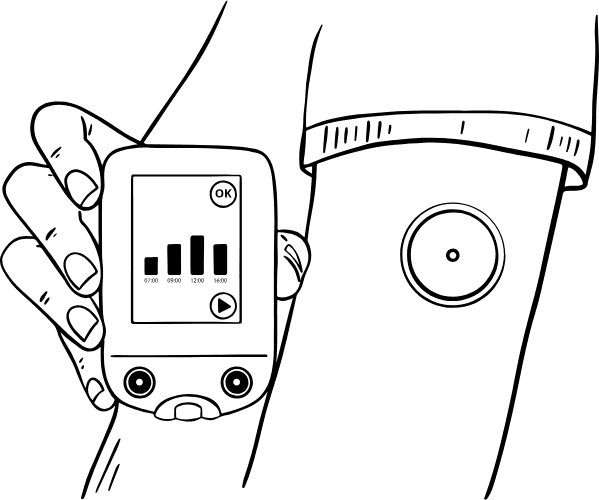
Continuous Glucose Monitoring (CGM) and Flash Glucose Monitoring (FGM) are both sensor-based technologies that provide real-time glucose data, but they differ in how they collect and display information.
What is CGM in Diabetes?
CGM systems (e.g., Dexcom G7, Medtronic Guardian Connect) provide continuous, real-time glucose readings, sending data automatically to a smartphone or insulin pump. They offer alerts for high and low blood sugar levels, making them ideal for patients who require tight glucose control.
What is FGM in Diabetes?
FGM systems (e.g., Abbott FreeStyle Libre) require the user to scan a sensor with a reader or smartphone to retrieve glucose readings. Unlike CGM, FGM does not provide real-time alerts unless manually checked, but it is generally more affordable and requires fewer calibrations.
Difference Between CGM and FGM
While CGM is better suited for intensive diabetes management, FGM provides a lower-cost, flexible alternative for patients looking for occasional monitoring without constant alerts.
Market Growth Trends for CGM & FGM
- The CGM market is projected to grow at a CAGR of 2% from 2024 to 2031, surpassing traditional glucose meters.
- Dexcom, Abbott, and Medtronic lead the CGM space, each developing new AI-powered features.
Leading Competitors in the Diabetes Market
Who Are the Major Players in the U.S. Diabetes Market?
The U.S. diabetes market is highly competitive, with leading pharmaceutical companies, medical device manufacturers, and digital health firms driving innovation.
As demand for advanced glucose monitoring, insulin delivery solutions, and non-insulin therapies grows, competition is intensifying across multiple segments, with a focus on affordability, digital integration, and patient-centric solutions.
Key U.S. Diabetes Market Leaders by Segment
Blood Glucose Monitoring Market:
- Abbott – FreeStyle Libre dominates the flash glucose monitoring (FGM) segment, offering affordable, long-lasting sensors.
- Dexcom – A market leader in continuous glucose monitoring (CGM), focusing on real-time tracking and AI-driven glucose analytics.
- Medtronic – Innovating in hybrid closed-loop insulin pump technology, integrating CGM with automated insulin delivery.
Diabetes Drug Market (GLP-1 & Insulin Therapies):
- Novo Nordisk – The leader in GLP-1 receptor agonists, with Ozempic® and Wegovy® driving market expansion.
- Eli Lilly – Rapidly gaining market share with Mounjaro™ (tirzepatide), a GLP-1/GIP combination therapy that has outperformed Ozempic® in trials.
- Sanofi & Pfizer – Expanding their biosimilar insulin portfolios to offer more affordable alternatives.
Insulin Delivery Market:
- Tandem Diabetes & Insulet (Omnipod) – Market leaders in insulin pump innovation, integrating AI-driven dosing algorithms.
- Medtronic – Developing next-gen insulin delivery systems with predictive AI technology.
- Novo Nordisk & Eli Lilly – Pioneering smart insulin pens and once-weekly insulin formulations.
Future Outlook for the U.S. Diabetes Market
Where Is the U.S. Diabetes Market Headed?
The U.S. diabetes market is expected to surpass $75 billion by 2031, with new drug formulations, AI-powered diabetes management, and digital health solutions driving innovation.
In 2025 and beyond, advancements in continuous glucose monitoring (CGM), flash glucose monitoring (FGM), insulin delivery systems, and GLP-1 receptor agonists are reshaping the industry.
Key areas of focus for the U.S. Diabetes Industry
The push for more effective, accessible, and patient-friendly treatments is driving pharmaceutical and medical device companies to innovate in drug formulations, advanced monitoring solutions, and AI-driven management tools.
Below are the key areas of focus that will drive the diabetes industry forward:
- GLP-1 therapies like Ozempic® and Mounjaro™ are expected to dominate due to their dual benefits of glucose control and weight reduction.
- Combination therapies (GLP-1 & GIP receptor agonists)—such as Mounjaro™ (tirzepatide)—are showing superior efficacy in clinical trials and are likely to replace older single-mechanism treatments.
- Oral GLP-1 therapies are emerging, offering patients an alternative to injections, improving adherence and long-term treatment success.
Advancing Non-Injectable Diabetes Treatments
The future of diabetes treatment is shifting toward non-injectable therapies that provide greater convenience and improved patient outcomes.
- Oral GLP-1 therapies and inhalable insulin are poised to disrupt the market, eliminating the need for injections in many cases.
- Inhalable insulin (Afrezza) is already available, and future formulations could further improve absorption and effectiveness.
- Once-weekly insulin injections (such as insulin icodec) could significantly improve patient adherence, reducing the burden of daily injections while maintaining stable blood sugar levels.
- The rise of smart insulin pens and AI-driven insulin delivery systems will make dosage tracking and adherence easier for patients, further improving diabetes management.
Scaling AI and Digital Health Integration
Technology is revolutionizing diabetes care, with AI-powered devices and digital health platforms making it easier for patients and healthcare providers to monitor, analyze, and optimize treatment plans.
- AI-powered CGM and insulin delivery systems are enhancing real-time diabetes management by automating insulin adjustments and predicting glucose trends.
- Wearable diabetes tech (smartwatches, glucose-monitoring patches, and AI-driven mobile apps) is becoming increasingly sophisticated, offering instant insights and alerts for better glycemic control.
- Telemedicine and remote patient monitoring (RPM) are playing a larger role in diabetes care, allowing patients to share real-time data with healthcare providers, reducing the need for frequent in-person visits.
- Personalized AI-driven treatment recommendations are emerging, helping optimize insulin dosing and medication schedules for individual patients.
Regulatory & Pricing Challenges
Despite the rapid advancements in diabetes treatments, pricing and accessibility remain significant challenges for both patients and healthcare providers.
- Increased government scrutiny on insulin pricing has already led to pricing caps and legislative efforts to improve affordability. In 2024, major insulin manufacturers committed to capping out-of-pocket costs, but affordability concerns remain a top issue for policymakers.
- More competitive pricing for CGM & FGM devices is expected as more companies enter the market, increasing competition and driving down costs.
- The reimbursement landscape for diabetes devices and medications is shifting, with insurance providers expanding coverage for CGM systems and GLP-1 therapies.
- The FDA is accelerating approvals for innovative diabetes treatments, allowing faster market entry for next-generation drugs and devices.
Summary
The U.S. diabetes industry is evolving rapidly, with GLP-1 therapies, AI-driven diabetes management, and digital health innovations leading the way. However, regulatory hurdles, pricing challenges, and insurance policies will continue to influence how these advancements reach the market.
Companies that focus on accessibility, affordability, and patient-centric innovation will be best positioned for long-term success in this growing market.
Get the Full Report Today
To explore the detailed analysis and data on the Dental Imaging Market, download the full U.S. Diabetes Market report. Gain valuable insights and informed perspectives to increase your revenue and improve your strategic approach.
Get the full report today and stay ahead in your industry.